
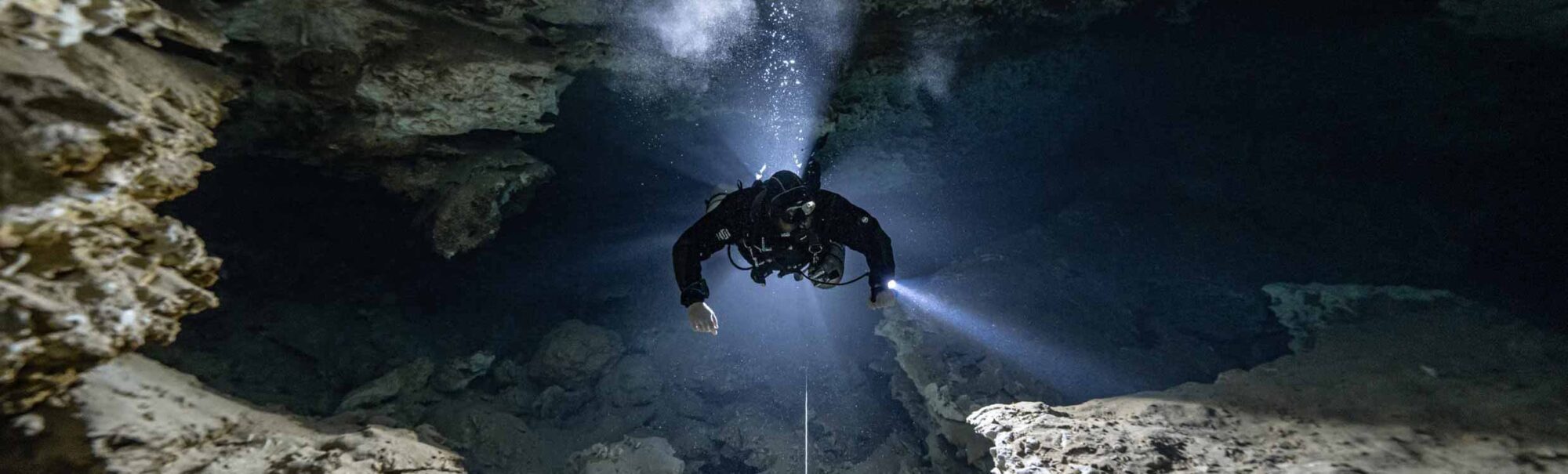
With over 6,000 Cenotes to choose from, it can be overwhelming to know where to start. Every month groups of cave divers come to Tulum and ask the same question: “Where do we start?” Some places in the world have strict guidelines for what cave dives you must do and in what order. However, in Mexico there is no official system or outlined recommendations for cave diving. Until now. The following dive recommendations are meant to be dived in the order given to follow a gradual increase in difficulty and to showcase a variety of cave styles.
Please note the following dives are suitable for CERTIFIED CAVE DIVERS. Not cavern divers. If you want to enjoy a dive in the overhead environment in Tulum but are not certified in cave diving please reach out to us to find out about our cavern tours or training.
If you are coming for 5 days of cave diving and you do not wish to have a guide the following list should give you plenty of fun experiences, a variety of cave aesthetics, and most caves have multiple different directions to allow for return dives without repeating cave too much.
SAFETY MESSAGE:
All cave dives carry a degree of risk. Please do your research, consult the descriptions below, plan ahead, reach out to local guides, and do not dive beyond your training or comfort level.
DAY 1: Cenote Cristal
Average Depth: 16m
Why is Cenote Cristal the Best Place for Your First Day of diving?
- Short Walk with equipment → If you need to fix or grab an item you won’t have to go far.
- Large open water area → ideal location for weight checks, S drills, and adjustments
- Distance → No matter where you are based in Tulum, it will not be a far drive.
- Size → Wide open passages with a variety of decorations.
- Repeatability → Numerous passages provide the opportunity for multiple days of diving.
Finding the Cenote and paying
Cenote Cristal shows up on Google / Apple Maps. It is directly next to the highway making it one of the easier cave dives to find in the area. When you arrive you will find a place to pay entrance fees for Cristal and Mayan Blue Cenote (your day two recommendation)
Opening Hours
Open 9 am
Close 4:30pm (Do not be late exiting the gate, they will lock you in)
(please note all times are in Mexican time so they do fluctuate wildly and with little notice)
Cave Entrance
Standing in the parking lot and looking at the cenote: if you were to swim half way into the cenote and turn approximately 90 degrees right you will see the large dark entrance with plenty of areas to make primary tie offs.
⚠️ ⚠️ Hazards of this Cenote ⚠️ ⚠️
Stairs → The stairs and rocks at Cristal are notoriously slippery. Please use caution when entering especially if wearing a twinset.
Jumping platform → on the far side of the cenote you will see a jumping off platform for tourists. I normally do not ascend close to that area as jumpers rarely are on the lookout for divers.
Where is the Mainline:
You will need to run a primary line and connect to the mainline. The mainline at Cenote Cristal is rather far back in the cave. Cenote Cristal is used as a training ground for divers, making it a great place for you to refine your skills in this new area. Once you have made a primary tie off and start heading down the slope you will see some sticks that have been stuck into the bottom to provide extra tie off locations. If you were to go in a straight line from the primary, down to a secondary and continue on a relatively straight line you will come across a large rock outcropping. Directly behind this rock outcropping is a stop sign (“Do not go further unless cave certified”). From this sign continue in a straight line with a SLIGHT 10 degree left and you will start seeing a rocky slope. Once you start heading up the rock slope the main line should be right there for you to tie into. If you are lucky another group will have gone in before you and you can simply lay a line parallel to them and connect in close by.
Dive 1. Mainline: Mainline, EoL JsR
Once connected the easiest shake down dive would be to stick to the main line. If you reach the end of the main line, you can jump from end of line to middle of line and go right or simply turn the dive.
While on the dive take some notes for your next dive(s). Approximately 2 minutes after connecting to the main line, you will see a double arrow with a possible jump very close to the left (this will be the recommendation for dive 2). Continue along the mainline taking note of the other arrows you will see and enjoying a darker cave than “normal” in the area. There is one minor restriction along the way. The restriction is easier for twinset divers and not too bad at all for sidemount divers.
Once you reach a limiting factor (Time, Depth, Gas, or other) simply turn and head back to your primary reel. I recommend removing any markers you placed on the way in, but leaving the primary reel in place so you do not have to relay your primary line on dive number 2.
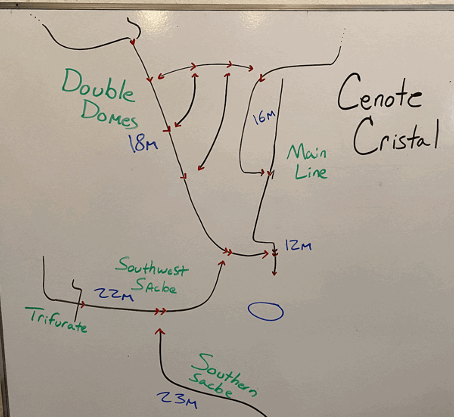
Dive 2. Double Domes: Mainline, Double Arrow Jump Left
Remember that double arrow jump about 2 minutes in after your primary reel? Thats where you’re recommended to go for dive 2.
This is the “double domes” line. This line is sometimes referred to as a little “spooky”. The halocline is usually right on the floor with large tall black decorations left and right, while having white floor peaking through the silt along the way. This line will have several jumps off of it that are not recommended for new divers in the area. Staying on this line will get you close to some black, yellow, and white decorations depending on how far you make it before turn.
↩ Click on the pic to learn more ↪
Trifurcate: Mainline, Double Arrow Jump Left, Double Arrow Jump Left, T Straight.
A very fun dive, nice white passages, will go in and out of salt water however will most likely require deco and the second jump is VERY long. And its cool to be able to “T Straight”. T Left is very short, T right is short and smaller, T straight is the best bet anyway.
Southern Sacbe: Mainline, Double Arrow Jump Left, Double Arrow Jump Left, Double Arrow Jump Left
Lots of jumping but even more white passages and decorations. Deco is almost guaranteed. Will be in an out of halocline.
DAY 2: Mayan Blue
Average Depth: 14-19m
Why Cenote Mayan Blue for Day 2?
- Halocline → a great cenote to fully experience halocline and adjust weights if needed.
- Options → tons of options accessible within a two tank range
- The View → Large blue salt water passages with white walls unique to the area
- Skills → great place to practice line work
Finding the Cenote and Payin.
Cenote Mayan Blue shows up on Google / Apple Maps and is directly next to the highway making it one of the easier cave dives to find in the area. When you arrive at the entrance you will find a place to pay for entrance for Mayan Blue and Cristal Cenote. Once you have paid for the entrance you need to cross the highway to access Mayan Blue. You drive down the road until it opens up to a parking lot. To the back left of the parking lot you will see a concrete wall and some tables for setting up equipment. Directly to the left of this concrete wall there is a footpath. This path leads to the cenote after a less than 2 minute walk. Follow the path around, go slightly right and you will see steps going down to the cenote with a small wooden platform for your tanks to the right.
Opening Hours
Open 9 am
Close 4:30pm (Do not be late exiting the gate, they will lock you in)
Cave Entrance(s)
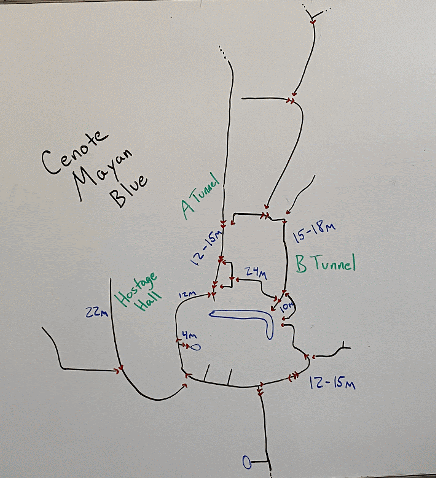
Mayan Blue has 3 different cave entrances. The main two are A and B tunnels. The third is the Dead Zone which is to the right of B tunnel.
For your first dives here I would recommend B Tunnel. Once in the water and checks completed if you put your back to the wooden platform and swim in a straight line 75m across the cenote you will arrive at a wooden staircase. Underwater to the left of this staircase you will find many great places to make your primary tie off. (or just use the bottom of the staircase itself)
(For reference upon entering the water the entrance of A tunnel is only 8-10m away from the wooden platform itself)
⚠️ ⚠️ Hazards of this Cenote ⚠️ ⚠️
Decompression → Depending on the dive you might want to bring supplemental 02 if certified to do so.
Stairs → stairs and rocks at Mayan Blue are slippery. Please use caution when entering, especially if wearing a twinset.
Jumping Rock → on the left side cenote you will see a jumping off area that tourists use. I normally do not ascent anywhere close to that area as jumpers rarely are on the lookout for divers.
Main Line B Tunnel
After making your primary tie off under or around the stairs at the far side of the cenote, go down the slope until you reach around a depth of 5m. Then turn left, keeping the slope on your left hand side and keep your depth constant and swim. After a few minutes the cave will open up and at approximately 8m below you, you will see the main line.
Dive 1 – B to A: Mainline B, EoL JsR
Being your first time in Mayan Blue I recommend staying on the mainline. There are several jumps off of the mainline that are suitable for you, so along the dive take note of all the jumps. The first jump is a 20m long jump left that goes to the “death arrow passage”, the second is a jump right that takes you to the “dead zone”, the third jump does not go very far, however the 4th jump is a double arrow jump that leads to E Tunnel. On this current dive however, if you reach EoL, jump to the middle of the line in front of you and go right. You are now on A Tunnel. After you turn the dive and exit, leave your primary reel in place so you do not have to relay the line for dive 2.
Dive 2 – B to Death Arrow Passage: Mainline B, JL, EoL JsR, EoL Turn.
For Dive 2 I would recommend Death Arrow Passage. So named because one of the arrows in the middle can be facing the “wrong way” depending on where you start your dive from. Take the first single arrow jump down to your left toward Death Arrow Passage. Note: depending on your decompression conservation settings you might want to bring O2 and leave it at 6m.
The jump to death arrow passage is approximately 20m down the slope to the left. After you do jump to death arrow passage you will most likely reach the end of line. Jump from the end of this line straight to the middle of the line in front of you and go right. This is the “bypass” line and is one of the more decorated passages in Mayan Blue. You will most likely not reach the end of line again. If you do, due to your average depth I would recommend turning the dive anyway due to your upcoming decompression.
↩ Other Notable Dives Here ↪
Hostage Hall: A Tunnel, JL, TR, JR
Hostage Hall is an enormous white salt water room that is well worth the trip. It takes some work to get there and you will have several major depth changes. Not suitable for anyone with ear issues.
E Tunnel: B Tunnel, Double Arrow Jump Right
Large salt water passages with decorations along the way. On your last dive to B Tunnel, if you went a long way past the double arrow, it might be worth it to jump to E Tunnel and enjoy. Decompression likely.
DAY 3: Cenote Jailhouse
Average Depth: 9-15m
Why Cenote Jailhouse?
- Variety of Directions → A T at the at the bottom of the slope close to the entrance means minimal repeating cave passages
- Line in open water → No need to lay a primary line
- Views → Dark initial areas that open up into spectacular salt water passages
Opening and Closing Hours
To the best of my knowledge Cenote Jailhouse does not have specific hours, however sometimes on Sundays the cenote will open late or might not open at all.
Finding the Cenote and Paying.
While the cenote is on Google / Apple Maps it can still be difficult to find. As you get closer to the cenote you should start to see some signs directing you to the cenote. Oftentimes people lose cell phone signal in this area so please search the cenote and have your gps running before you lose signal. Once you arrive you will see a large concrete building on your left, drive past this slightly and turn into the gate on your left. Most parking spaces are less than 20m from the cenote. The cenote is not popular for swimming so there is currently (2025) no formal payment area, usually one of the staff will come by and ask for payment. I usually start getting ready and carrying tanks to the water, within 15 minutes someone comes by and asks for entrance, if not you should go find a staff member before you start your dive.
⚠️ ⚠️ Hazards of this cenote ⚠️ ⚠️
Visibility → In the first 5-6m of the dive visibility will be highly limited.
Silt → down to the T the bottom of the slope is covered in delicate silt
Arrows Change Directions →Depending on your cave experience this might be your first encounter with arrows changing direction in a cave, have a plan for this.
Main Line
The main line is tied to a white float in the cenote. The cenote has been expanded artificially and now the easiest thing was to tie the cave line to a float. Standing on the stairs from the parking lot looking at the cenote on the right hand side you should see a round white float. That is the start of the cave line. Due to continued expansion you might see other floats, hoses, and ropes in and around the cenote. I recommend descending less than 1m away from the line, holding if needed.
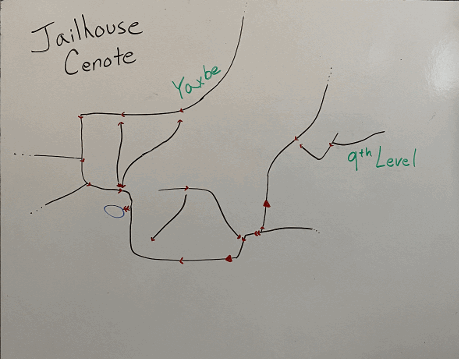
Dive 1 – Yaxbe: TL, TR, TR
There are a couple of ways to get to the Yaxbe passage, I will share here the simplest. Although if you look at the stick map below you will see some alternate routes. As you descend and the visibility clears you’ll follow the line until you see a T on the slope. TL on dive one. The next T go Right, shortly after there another T go Right again and swim. The first 15 minutes of the dive will be in darker passages but as soon as you pass into the halocline the passage will open up and become more decorated and wide – this is the Yaxbe passage. With only 2 tanks the odds of you hitting EOL are almost 0, so swim and enjoy.
Dive 2 – Mainline: TR, TL
For this next dive, T right at the bottom of the slope. This passage will start off dark then take you in and out of the salt water many times. The next T will be inside the halocline, and you should go T Left. After this T the arrows will face “away” from you. The first arrow you will come across will be one of the “old style” arrows that is much larger than today’s standard. Along this dive you will go in and out of the salt water many times and the size of passage will change several times. If you make it past the next arrow you are now getting close to the border between what is considered Jailhouse and Mayan Blue. For the more adventurous and certified traverses are possible, they just require many more tanks.
↩ Other Notable Dives Here ↪
Yaxbe Shortcut: TL, JR, EoL JsR
If you want to go further down Yaxbe you can cut a lot of time off your journey by taking one of the two shortcuts. TL then the next arrow actually signals two jumps to your right. As shown on the stick map above they both go directly to Yaxbe.
9th Level: TR, TL, JR, TR
Not suitable for two tank cave divers. The 9th level is a fun little passage that gets small from ceiling to floor the further you dive on it. Please note if you take this jump it gets VERY decorated VERY close to the line. Please move slowly, do not be afraid to pull and glide, and keep your feet down. Stay as close to the line as you can, and do not be afraid to turn early.
DAY 4: Cenote Minotauro
Average Depth: 11m
Why is Cenote Minotauro Next?
- Shallow → Shallow average depth = longer dives
- Options → Tons of navigational options so multiple dives here are easy
- Traverses → Multiple cenotes in the area so traversing is possible with 2 tanks.
- Variety of style → Every 10 minutes the size, color, or shape of the cave changes.
Opening Hours
9am – 5pm
Finding the Cenote and Paying
The cenote is easily found on Google / Apple Maps. As you turn into the cenote entrance there will be a large black gate that is usually opened by the staff. If no one comes to help you can either give your horn a short push or open the gate yourself. Please note if you open the gate please close it behind you as they have many animals close to the entrance. Driving forward 5-10m you will see a building on your right, by entering here you will find a place to check in and pay. This cenote sometimes asks to see cave diving certifications so have them ready. After checking in there is only one road to follow, it will turn to the left away from the highway and you will continue straight until you reach the cenote. You will know you’re in the right place when you see a church in front of you, a pool to your left, and a cenote to your right.
Cave Entrance
From the parking lot you walk toward the cenote and descend the stairs. Continue straight walking on the path until you are at the far side of the cenote. You will see some wooden steps to the water, around here is a good place to leave your tanks.
⚠️ ⚠️ Hazards of this cenote ⚠️ ⚠️
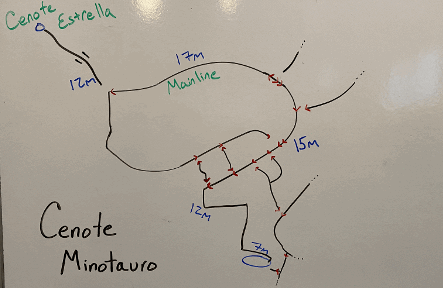
Navigation → If this is your first time in this cave please keep your dives simple. Arrows change directions, multiple cenotes, and lines that circle back on themselves; all this means dives can get very confusing surprisingly quickly.
Ears → Depth fluctuates multiple times here
Main Line
Once in the water, place your back to the wooden stairs, to your left starting at a depth of 2m, in open water is the upstream main line. (To access the downstream mainline you will need a short primary reel. With your back to the stairs if you swim straight away from the stairs 8-10m, make a primary tie off and look to your right, you will see an arch and the downstream line is in the middle of that arch).
Dive 1: Mainline
Mainline Minotauro is the dive I take people on when they don’t know what kind of cave they like. This line has it all. Along the dive take a moment and try to spot where all the jumps go. With 2 tanks you will most likely make it to the opposing arrows marking the middle point of a popular circuit. Make the opposing arrows correctly and continue. Simply stay on mainline until you reach a turning factor.
Dive 2 – Estrella: 2JL, EoL JsL, 2JL
Next dive will be mainline again, however now we are going to take the 2nd Jump Left. This line is a short connection line back to the far end of the main line. Follow this line until the end of line and you will see another line in front of you, jump to the middle of this line and swim left. You will quickly pass a jump left, ignore this and go to the second jump left. You might not see this jump immediately as the line is slightly above you to your left on a rock. Connect here a the arrow on the line should say “Estrella”. Diving on this line will pass you through big places, smaller, good decorations, the infamous “sandwich” restriction, and fossils. If you make it to the end of the line you have the option of surfacing in Cenote Estrella and having a view of the beautiful jungle. Most people make the traverse or turn shortly before.
↩ Other Notable Dives Here ↪
Downstream: TL, TL, JL, TR, EoL JsR
Very engaging cave and a little more navigation for a diver who wants a little bit of a challenge. Please be aware many places will have decorations close to the line. Not advised for twinset divers.
DAY 5: Chan Hol
Average Depth: 6-8m
Why Cenote Chan Hol?
- Depth → with a very shallow average depth you get the possibility for very long dives
- Decorations → Chan Hol is one of the more decorated caves we have in the area. Please swim slowly and use extreme caution.
- Color → This is the first almost completely white cave on the list. Making it a very bright experience.
Opening hours
9am – 6pm
Finding the Cenote and paying
Cenote Chan Hol is located about a 10 minute drive away from Tulum down the main highway. The cenote is on Google / Apple Maps. The cenote is in the front lawn of the land owner and is located in the front. You will want to park at the wooden tables you see as you drive straight through the gate. After pulling off of the highway you will only have to drive another 30-40m until you are parking at the cenote. The cenote is below the wall that separates the owners property from the highway. Usually as you are gearing up the land owner will come by and collect entrance money. If he does not, simply make sure you pay after your first dive, very nice man.
Cave Entrance
As you walk down the path you will see the very small cenote at the bottom. If you are facing the water from the path the cave entrance is directly below the rocks on the back of the cenote. The cave line is attached to the ceiling and starts just out of the water. Hard to see from the area you get ready. Note due to the cenotes size often times more than 3 people have a very awkward time getting ready at the same time so potentially stagger if you are multiple groups.
⚠️ ⚠️ Hazards of this cenote ⚠️ ⚠️
- Stinging Insects → Chan Hol is notorious as a place where mosquitoes, tabanos, and bees live. Bring mosquitoes coils, or egg cartons to burn. Please do not put on insect repellent if you are wetsuit diving as it will wash off in the water and impact the environment.
- Distance Stress → With an average depth of 6m, one of these dives could be your longest yet. Never be afraid to turn a dive, it isn’t every day you end up 60+ minutes from your exit.
- Side passages → Please stick to the route listed below, this cave has many side passages that get very small, silty, delicate, and dangerous.
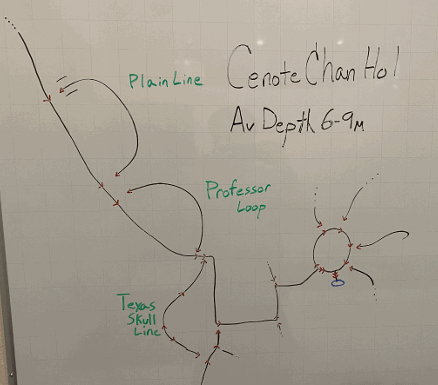
Dive 1 – Mainline: TR, TR
If it is your first dive ever at Chan Hol I would highly recommend staying on the mainline the whole dive and spotting all the potential jumps. As you descend into the cave you will find a T directly at the bottom of the slope. This T connects with another T offering you the chance to make a complete circle. On Dive 1 I would recommend going TR, then TR as to not repeat too much cave and to spend this dive spotting all the jumps after the 2nd T. High vaulted ceilings, white decorations, and engaging cave make this one of the nicest dives in the area. Enjoy. Please do not take any of the jumps between the two Ts, the get highly silty, decorated, and dangerous if you go the wrong place.
Dive 2 – Professor to Plain: TL, TL, 5JR, EoL JsR, Next JR, EoL JsR
Your next dive would be going T right at the start followed by another T right a 5-7minutes later. Now you can start counting the jumps. Your 5th marked jump should be a jump right. This is the start of the “Professor Loop”. Take this jump. Continue until you reach the end of the line and jump back to main line, and go right. Your very next jump should be a jump right and is the start of the “Plain Line”. Take this jump. Most people hit their turn pressure while on this line. Anywhere on this line is a good place to turn around except for the last 30 seconds of the line. So if you are diver number 1, and your reach the end of the line and decide its time to turn, do not try to turn exactly where you are. If diver number 1 is looking at the end of the line, divers 2 or 3 are directly underneath and surrounded by a very decorated area. It is a good idea for diver number one to move 3-4m forward to allow divers 2 and 3 a much better place to turn around. If Diver 1 sees the end of the line and has plenty of gas left, you can choose to jump from end of line to middle of main line, and go right.
↩ Other Notable Dives Here ↪
Texas SKULL Line: TL, TL, 3rd Jump Left, 2nd Jump Right
Not Suitable for Twinset Divers: Note you will have 1 minor restriction along the way, and the arrows will change direction. But it is a very shallow and well decorated line.
All set up! Now, dive safe!